Christopher Nolan: The Definitive, Subjective Ranking
In anticipation of The Odyssey, I rewatched Nolan's films to solidify how I felt.

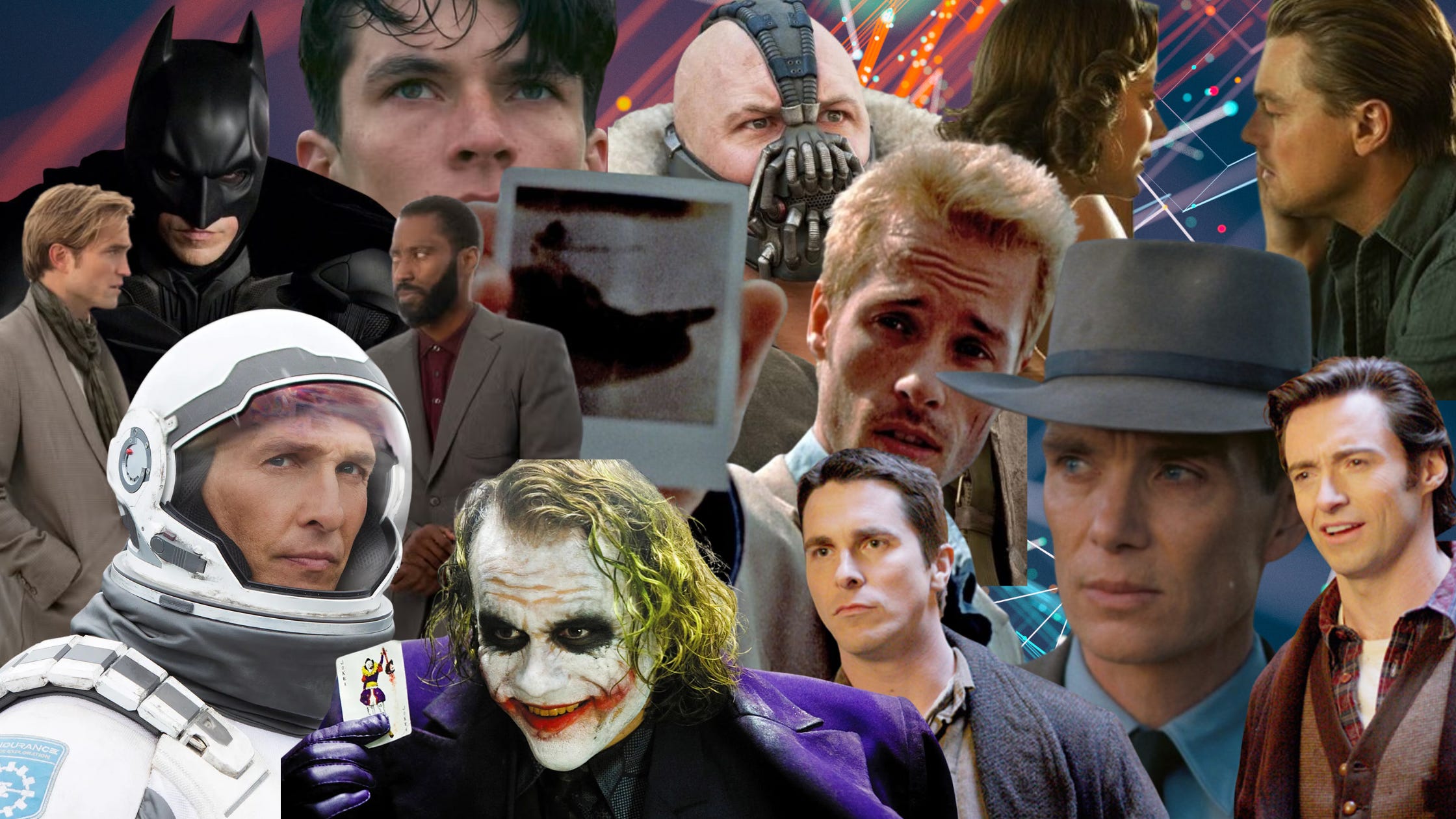
I so enjoyed the homework of ranking Wes Anderson’s films I immediately threw myself into another project.
Christopher Nolan was the logical choice here, because I already hold so many of his movies in high regard, and between Oppenheimer, last year’s best picture winner, and The Odyssey, next year’s epic must-see, Nolan remains as relevant as ever.
From “worst” to “best,” here is my ranking of every Christopher Nolan film, with the exception of Insomnia, because he did not write it, only directed it. I considered doing a bit, where my favorite part of each movie would be where we learn about the dead wife, but I didn’t want that kind of karma on my hands.
Unlike my Wes Anderson rankings, there was no clear dividing line for me. There are a lot of moving parts and I’m only certain of the placements of one and two. Three, four, and five are interchangeable for me, and the rest might change five years from now.
And as before, I will not be taking questions at this time.
10. Batman Begins (2005)
I’m sure few readers will pushback here—and that’s not to say Batman Begins is a bad movie in any way. Rather, it has the unenviable task of setting up its sequels and laying the foundation of a superhero franchise. So while it does stand alone in some respects, it’s primarily an origin story that doesn’t leave me thinking about it in a larger philosophical sense. It feels like the most “traditional” of his films.
Favorite Moment: When Batman uses one of his gadgets to pull a man to the roof, where he hangs the man upside down to get information. The man says, “I swear to God,” and Batman yells in that (in)famous voice, “Swear to me!”
9. Memento (2000)
Here’s where I’m braced for pushback. I understand this movie is significant to plenty of movie watchers who came of age at the turn of the new millennium. Again, all of these movies are good, but perhaps it’s because I was already past thirty by the time I watched that it didn’t resonate with me the same way. In a technical, constructive way, I think it’s a wildly interesting and successful movie. But tonally and stylistically, it sometimes feels like a poor man’s Fight Club, and it’s missing the maximalism I’ve come to enjoy from the usual Nolan flick.
Favorite Moment: When Leonard’s memory refreshes as he’s running, and he can’t decided if he is the hunter or the prey of the chase scene. It’s a tense moment given the circumstances, but also funnier than Nolan tends to be.
8. Tenet (2020)
Tenet is, if anything, very cool. John David Washington? Cool as fuck. Robert Pattinson? Cool as fuck. Elizabeth Debicki? A bit of a damsel, but cool as fuck anyway. The whole notion of time inversion / reversing someone’s entropy is very inventive and perfectly suited for a Nolan movie, but it suffers from muddied motivations, few emotional stakes, and too much shrugging when it comes to the why things are happening and how they are meant to work.
Favorite Moment: I really enjoyed when the Protagonist and Sator have the interrogation in the rooms that have are time-inversed. It was creative and choreographed really well, even if I still have trouble understanding how they actually understood one another.
7. The Dark Knight Rises (2012)
There are so many things I really love about this movie. Anne Hathaway’s Selina Kyle. Tom Hardy’s Bane. Marion Cotillard as Talia al Ghul. I think it’s a noble and fairly successful follow-up to something as brilliant as The Dark Knight, but it does get a little too big at points, and perhaps too on the nose. It’s an obvious byproduct of Obama-era Wall Street antipathy, and in its politics, we lose some freedom for personal analysis. It’s just a bit too loud with its message, but damn if it’s not a whole lot of fun.
Favorite Moment: I think a lot about the football field crumbling to pieces, but for this I landed on the scene when Bane gently places his hand on Dagget’s shoulder and says, “Do you feel in charge?” Woof.
6. Dunkirk (2017)
Dunkirk is so damn satisfying on a second and third watch. The three timeline structure is both thrilling and fluid, and the scope of the beach scenes captures a specific kind of trapped feeling that’s necessary to push the movie forward. It’s a technical achievement, but it lacks (like many of the non-Jonathan Nolan films) an emotionality that I tend to gravitate towards. We know very little about any of the characters and thus can only connect so much. We want them to live because it’s better than dying. There is no dead wife in this movie, but it really could’ve used something like a dead wife, so that we had an emotional anchor for these soldiers’ return.
Favorite Moment: It’s small, but towards the end, when an older man is congratulating the soldiers, Harry Styles’s character says, “All we did is survive,” and the older man says, “That’s enough.”
5. The Prestige (2006)
I rewatched these films in chronological order, which meant this was the second film I watched, and upon finishing it, I texted my friend Bill and said, “I can’t believe this isn’t his best film.” That’s the magic of Nolan. The Prestige is a vicious portrait of artists, their craft, and the lengths one will go to be the best. Like The Dark Knight two years later, this is a movie of dualities—doubles and rivals—but this one features more twists. I’m surprised Hugh Jackman hasn’t returned to Nolan, and hope that he will have the opportunity to do so. It is somewhat quiet compared to his other films, but just as rich, and could go as high as three on this list if not for the stiff competition.
Favorite Moment: It only works on a rewatch, but when Rebecca Hall’s Sarah says to Borden, “Some days you mean it, some days you don’t” in reference to his love, I do a little fist pump because damn if that ain’t tasty once you know who Fallon really is.
4. Inception (2010)
I don’t think it’s a stretch to argue that the arrival of Inception was a cultural moment, one that either capped the 2000s or launched the 2010s (depending on your perspective of when a decade starts or begins). The movie is a feat on multiple fronts: the creative approach to layered dreams, the practical approach to its ideas, and the emotional framework of Mal and Cobb’s relationship. It does crumble a little bit if you ask to many questions, but I adore Marion Cotillard in this film, and like Jackman, would love to see Leo return to a Nolan film soon. The ambiguity of the ending is perfect, because the emotional resolution isn’t ambiguous at all. Cobb is back with his kids, whether it’s a dream or not.
Favorite Moment: It has to be when Cobb is teaching Ariadne how to construct the space of the dream, and she begins to fold the buildings, and by extension, the physical reality of Paris. I feel like it incepted an artistic point of view for me as a writer.
3. The Dark Knight (2008)
When I started this project, this was number two. Then, when I wrote this list, it fell to number five. Then, in writing this paragraph, I wrote myself into moving it back up. The Dark Knight is incredible. Any complaints I have for this film are essentially nitpicks, but the way Nolan and crew wield "duality” and “nihilism” as instruments for storytelling is wildly sophisticated in its simplicity. Joker vs. Batman. Harvey vs. Bruce. Prisoners vs. Free citizens. Chaos vs. principle. Man vs. symbol. The literal duality of Two-Face. I’ve seen this movie at least thirty times (twenty in 2008-2009 alone, when I was a freshman in college), and it never fails to be a riveting experience. There’s nothing new to say about Ledger’s joker. So, why was it five? Mostly because I wanted to reward the other films for not being superhero movies, which I decided was a bad reason to lie to myself.
Favorite Moment: The interrogation scene, while sometimes mocked, is one in which all the tension of the movie is felt. Batman’s violent hatred for the Joker is palpable, but the Joker cannot be defeated, because the one thing he wants is the one thing Batman won’t give him.
2. Interstellar (2014)
It’s number two on the list, but it’s number one in my heart. Interstellar is the one Christopher Nolan film that really nails that combination of emotional heft (Matthew McConaughey's ability to weep for his daughter and still somehow father her at the very end always guts me) and maximalist, cinematic viewing (we’re talking about wormholes and rescuing the human race). It plays with time, but operates on a steady foundation of relativity, and with each watch, the concept of Murph’s “ghost,” reads even more beautiful to me. This most recent watch was the first since I’ve become father to two, so how could it not crush me. Would I, if qualified, leave my kids behind to explore the remote possibility of finding them a new planet? I don’t know. Probably not!
Favorite Moment: Maybe this is contentious, but I adore the physical rendering of the time dimension after Coop travels through the black hole. The “strings” he has to play in order to fulfill a destiny he likely set for himself are so damn cool. I could stay in that scene for another half hour.
1. Oppenheimer (2024)
I had my doubts, watching this film again, that it would fare as good on the second watch. After all, the Trinity Test scene is so fantastic in a first-time, theatrical experience, I figured the movie might fall flat on my smaller screen at home. But it does not fall flat, and Cillian Murphy’s performance only gets better on repeated viewing. What specifically vaults Oppenheimer to the top is not just its scale, but it’s ability to dramatize through cuts. The emotional stakes exist in Murphy’s talent for wearing remorse. The tension is created through precise exits and an interwoven bit of storytelling. I’m more emotionally connected to Interstellar, but Oppenheimer is the more impressive feat.
Favorite Moment: The easy answer would be the Trinity Test, but I think a lot about the opening of the movie, when Oppenheimer tries to poison his professor for humiliating him, and the fun of him slapping the apple out of Bohr’s hand.