Reading Roundup — April 2026
On Emily Nemes, Sarah Domet, Neil DeGrasse Tyson, Kate Fagan, and Miranda Mellis

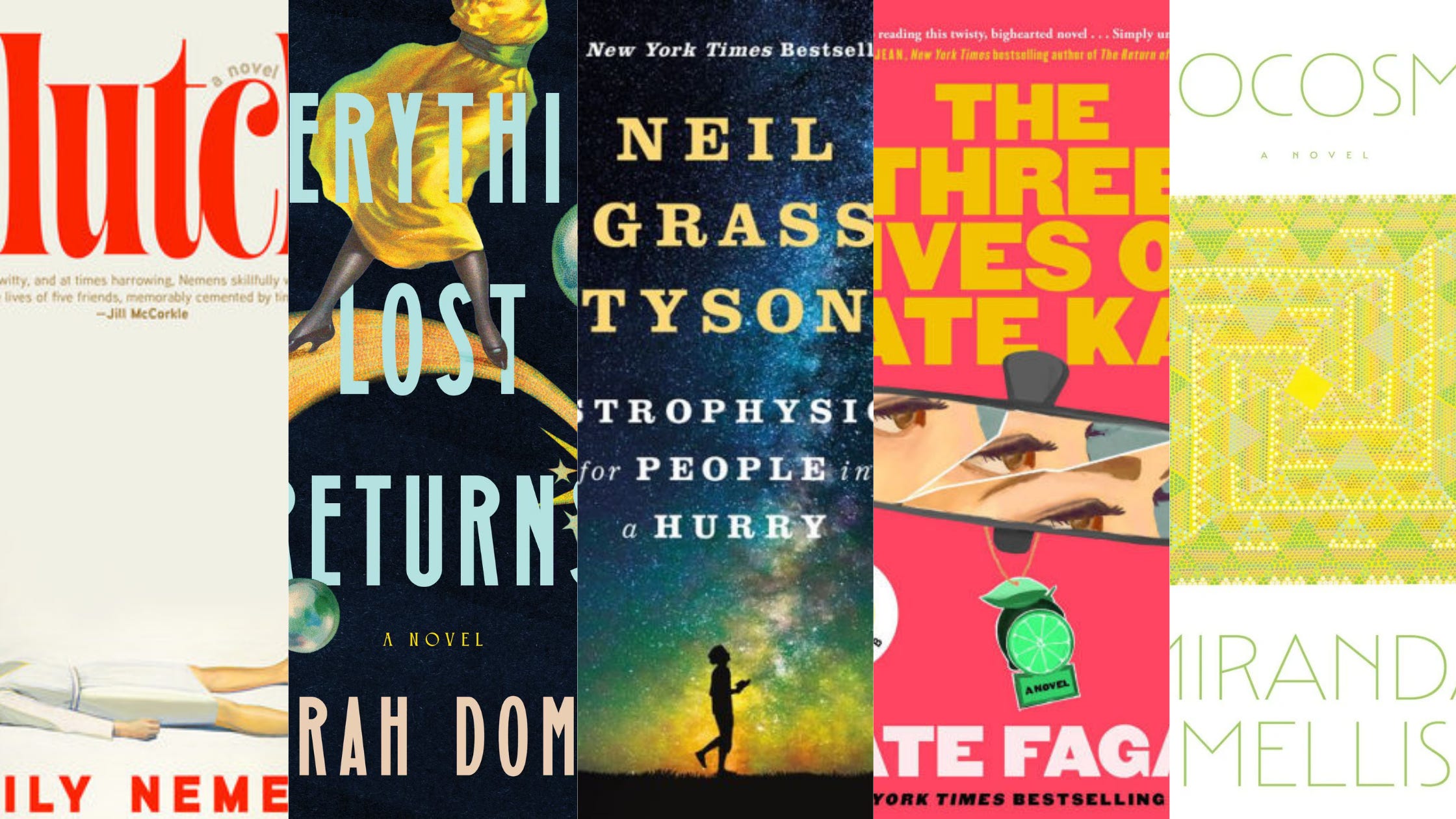
Clutch by Emily Nemens (2026)
Despite the marketing, this book isn’t much like White Lotus at all (unless you’re only talking about the blonde blob of Carrie Coon, Michelle Monaghan, and Leslie Bib in season three), but that doesn’t mean I didn’t enjoy it.
It’s a bit of a slow start. One that’s so character-drive and sporadic it takes you a minute to settle into the read. Kind of like driving stick. The sequence isn’t clear until you really find your ear for it.
And my ear started to hear something like an oral history. The book sets you up to think it will take place over one weekend getaway, a quick reunion for all these women in which everything will go down—but then it swiftly returns them home, separating the cast. Thus, everything becomes a bit disjointed for effect.
Clutch reads like a prequel to something that may never come, but that’s alright. It’s immersive, less concerned with the traditional machinations of story and more interested in getting to the core of each of these women. Nemens writes fiercely and unapologetically, capturing a modern exasperation that many of us, especially women, can’t shake.
Some characters are more interesting than others, but I bought into their totality. People shed themselves from your life. Others hang on like barnacles. Everyone in this group felt somewhere in between.
I’d be really interested in a leaner version of this book, one with 50% less detail and maybe 70 fewer pages, but perhaps that will find itself in a spinoff of sorts. I’d read the metatextual novel that Carson is writing. Or, I’d simply follow her life in New York separate from the other girls.
Just like her novel The Cactus League, Emily Nemens isn’t unafraid to do something different with structure and form. I appreciated the way texting and group chats were wielded throughout. I also enjoyed that there was no clear delineation as perspectives shifted. Rather, it was fluid and a bit discomfiting, which is a much bolder choice.
And of course, every reference to baseball made me smile.
Everything Lost Returns by Sarah Domet (2026)
It was a long wait since The Guineveres, but it was absolutely worth it.
I’ve been thinking a lot about this one since I finished it, because I admire how tightly interwoven the narrative is. There’s a lot of content, plenty of insight, ideas, and humanity to chew on, all balanced evenly across 300 pages or so.
Though I give kudos to the fluid perspectives in Clutch, I also enjoyed how Everything Lost Returns is clearly structured as a back-and-forth between characters, probably because these characters exist across time. When a narrative is broken in half like this, one side can tend to feel heavier than the other, making a reader like me pay less attention to one of the protagonists. But Sarah Domet does a damn good job giving each its due in this one.
From 1910 to 1986, we follow two women who work for the same soap company and the parallel shapes of their lives. The shift in point-of-view styles (third person for Opal, first person for Nona) is really effective, and despite that distinction, the echoes of their stories still ring clearly throughout the book.
Sarah Domet has somehow taken a story about soap, public performance, and Halley’s Comet, and turned it into something absolutely riveting. These are the stories I love: grounded reality, rooted in historical truth, but woven with a splash of magic you can’t help but believe is real.
And as far as I’m concerned, the magic is real.
There are two moments that will stay with me, probably because they are actually one moment, which is what makes the book so tasty. There’s a baby’s cry that echoes across time, one that is central to the mechanics of the story, and it really works. There are other moments, too, in which the emotional beats repeat in a satisfying way.
It’s a tightly constructed, fully formed story I am happy to recommend to most readers.
Astrophysics for People in a Hurry by Neil deGrasse Tyson (2017)
What a time to be alive, but also how frustrating it is to know there is plentiful to be discovered well after I’m gone. It pains me to know that for a subject in which I only understand a small fraction, the full understanding is an even smaller fraction of the total unknown.
The title is apt, but it doesn’t make clear that you need some foundational knowledge in physics and other sciences before diving in. Fortunately, I love physics, have been curious about quantum mechanics for quite some time, so I was able to hold my own through most of the reading. But holding my own doesn’t mean I came away with complete comprehension of the material.
I don’t have much to say about Tyson as a writer. He is succinct and expresses big ideas in a warm, conversational voice. The book is what it claims to be, which makes it a success in my eyes.
The chapters on dark matter, dark energy, and the space between planets were my favorite, and the closing reflections were quite a beautiful way to close the book. I’m not walking away an expert by any means, but the book did wonders to explain truths I feel somewhere in my core, and the more I read about the cosmos, the more certain I am in my personal philosophy.
If you’re even a little interested in the cosmos and the laws that govern and bind our universe, I recommend cracking it open. Tyson covers a swath of ideas and principles, and I will likely end up pursuing one or two of them in the future.
The Three Lives of Cate Kay by Kate Fagan (2025)
Admittedly, I was a little fucked up after reading about the universe (and theoretical multiverse), so I decided to read a book a friend had read with the intention of grounding myself and recalibrating my brain.
This might have been an overcorrection.
I knew going in, though, that the book likely wouldn’t be good, these kinds of books never are, but it would be easy. So, I spent most of the time reading searching for things to like.
For instance, the novel is structured as a memoir written by the titular Cate Kay. The memoir features chapters written by important characters in Cate’s life, offering a tapestry of perspectives so we can get a fully formed picture along the way. The metatextual nature of the book sets it apart from the usual poorly written slop of this genre.
But lines like “Janie was good at empathy” and “I felt my whole body fill with awareness” are just too awful to reward much else.
There’s also the problem of voice—in that every character seems to have the same one, regardless of their temperament, gender, or background. It was an ambitious project, and unfortunately Fagan wasn’t successful in that regard. I wanted to like the book more, because I like her sports journalism, but this one was just one big eyeroll.
Some steamy sex scenes, though.
If you end up reading it, here’s a good drinking game: knock one back every time “picture” is used as a verb in this book.
Crocosmia by Miranda Mellis (2025)
Speaking of ambitious projects.
Reading through other reviews, you’ll find a notable number of readers who found Crocosmia “pretentious” and “a word salad.” I don’t think that impression is wrong, it’s got a lot of high-brow language stuffed into a short novel—but salads aren’t without their merit.
And fork around a bit, and you’ll find something interesting buried in the prose.
Miranda Mellis is clearly interested in politics, and language, and the politics of language. There’s a clear thesis here that all our beliefs (social and spiritual) stem from an evolution of semantics, which is interesting, certainly. We wouldn’t be reading and writing if language didn’t interest us.
The problem is the book is a bit smug about those ideas. It reads self-righteous, even to a reader who may agree with those ideas. It doesn’t allow space for much nuance and independent thought.
The framing of the story—in which seven heads of state are simultaneously beheaded, and giant flowers grow in their place—is fantastic. Amazing stuff. Especially when it explores the telekinetic source of those beheadings and speaks of it plainly. As a fable / speculative fiction, I found it had a lot of juice.
Ultimately, it falls a little short for me because the emotional heft wasn’t quite there. In all its ideas and concerns for humanity at large, it ultimately comes off cold and rigid, leaving me wondering if the story is a lecture disguised as a fable. There’s plenty of moral and not enough story. I don’t need plot, but I do need to feel something, and I can’t say I felt much at all other than an admiration for the language, which is something!
It is a cool and worthy read, though.